Minutes to Decimal Calculator and Conversion Chart
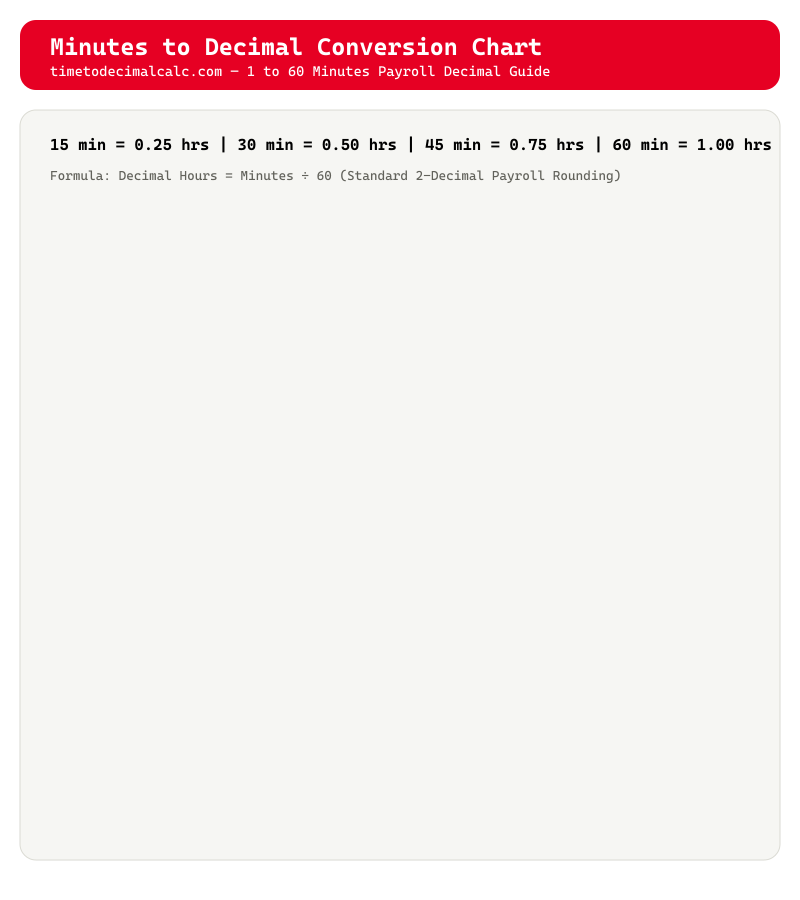
Minutes to decimal conversion converts minutes into fractional decimal hours by dividing the minute count by 60. For example, 15 minutes is 0.25 hours, 30 minutes is 0.50 hours, and 45 minutes is 0.75 hours. Our interactive tool and printable 1 to 60 chart provide instant reference for payroll processing and billing.
Step-by-Step Calculation
- Formula: Decimal Hours = Minutes ÷ 60
- Divide minutes by 60: 30 ÷ 60 = 0.50 hours
Complete Minutes to Decimal Conversion Chart (1–60 Minutes)
Standard payroll conversion table rounded to two decimal places (hours ÷ 60). Tap any row to highlight.
| Minutes | Decimal | Fraction |
|---|---|---|
| 1 min | 0.02 hr | 1/60 |
| 2 min | 0.03 hr | 2/60 |
| 3 min | 0.05 hr | 3/60 |
| 4 min | 0.07 hr | 4/60 |
| 5 min | 0.08 hr | 5/60 |
| 6 min | 0.10 hr | 6/60 |
| 7 min | 0.12 hr | 7/60 |
| 8 min | 0.13 hr | 8/60 |
| 9 min | 0.15 hr | 9/60 |
| 10 min | 0.17 hr | 10/60 |
| 11 min | 0.18 hr | 11/60 |
| 12 min | 0.20 hr | 12/60 |
| 13 min | 0.22 hr | 13/60 |
| 14 min | 0.23 hr | 14/60 |
| 15 min | 0.25 hr | 15/60 |
| 16 min | 0.27 hr | 16/60 |
| 17 min | 0.28 hr | 17/60 |
| 18 min | 0.30 hr | 18/60 |
| 19 min | 0.32 hr | 19/60 |
| 20 min | 0.33 hr | 20/60 |
| Minutes | Decimal | Fraction |
|---|---|---|
| 21 min | 0.35 hr | 21/60 |
| 22 min | 0.37 hr | 22/60 |
| 23 min | 0.38 hr | 23/60 |
| 24 min | 0.40 hr | 24/60 |
| 25 min | 0.42 hr | 25/60 |
| 26 min | 0.43 hr | 26/60 |
| 27 min | 0.45 hr | 27/60 |
| 28 min | 0.47 hr | 28/60 |
| 29 min | 0.48 hr | 29/60 |
| 30 min | 0.50 hr | 30/60 |
| 31 min | 0.52 hr | 31/60 |
| 32 min | 0.53 hr | 32/60 |
| 33 min | 0.55 hr | 33/60 |
| 34 min | 0.57 hr | 34/60 |
| 35 min | 0.58 hr | 35/60 |
| 36 min | 0.60 hr | 36/60 |
| 37 min | 0.62 hr | 37/60 |
| 38 min | 0.63 hr | 38/60 |
| 39 min | 0.65 hr | 39/60 |
| 40 min | 0.67 hr | 40/60 |
| Minutes | Decimal | Fraction |
|---|---|---|
| 41 min | 0.68 hr | 41/60 |
| 42 min | 0.70 hr | 42/60 |
| 43 min | 0.72 hr | 43/60 |
| 44 min | 0.73 hr | 44/60 |
| 45 min | 0.75 hr | 45/60 |
| 46 min | 0.77 hr | 46/60 |
| 47 min | 0.78 hr | 47/60 |
| 48 min | 0.80 hr | 48/60 |
| 49 min | 0.82 hr | 49/60 |
| 50 min | 0.83 hr | 50/60 |
| 51 min | 0.85 hr | 51/60 |
| 52 min | 0.87 hr | 52/60 |
| 53 min | 0.88 hr | 53/60 |
| 54 min | 0.90 hr | 54/60 |
| 55 min | 0.92 hr | 55/60 |
| 56 min | 0.93 hr | 56/60 |
| 57 min | 0.95 hr | 57/60 |
| 58 min | 0.97 hr | 58/60 |
| 59 min | 0.98 hr | 59/60 |
| 60 min | 1.00 hr | 60/60 |
Why You Need a Minutes to Decimal Chart
In modern timesheet management, recording minutes accurately is the foundation of lawful payroll. Calculating employee pay requires multiplying hourly wages by total hours worked. Because standard time divides the hour into 60 minutes, multiplying an hourly rate of $20.00 by 8 hours and 30 minutes directly yields inaccurate results unless the 30 minutes is first translated into 0.50 decimal hours.
Our minutes to decimal chart provides an authoritative, printable reference guide for all 60 minutes of an hour. Whether you are reconciling paper time cards, auditing automated electronic punch clocks, or billing client accounts, this reference table eliminates guesswork. You can also convert full shifts using our Time to Decimal Calculator or reverse calculations with our Decimal to Time Calculator.
How to Convert Minutes to Decimal Manually
Converting minutes to decimals requires dividing the minute figure by 60:
- Identify the minutes: Take the exact number of minutes recorded (for example, 48 minutes).
- Apply the division rule: Divide the minutes by 60:
48 ÷ 60 = 0.80. - Combine with whole hours: If the total shift was 8 hours and 48 minutes, your result is 8.80 decimal hours.
- Determine compensation: Multiply the decimal hours by the hourly pay rate. At $25.00/hour, 8.80 hours yields
8.80 × $25.00 = $220.00gross pay.
Key Minute Milestones for Payroll
Understanding the core fractional increments helps prevent payroll submission mistakes:
- 15 Minutes (0.25 Hours): Exactly one quarter of an hour. Widely used as the standard billing unit by law firms, accountants, and freelance professionals.
- 30 Minutes (0.50 Hours): Exactly half an hour. The statutory unpaid lunch break duration in many US states.
- 45 Minutes (0.75 Hours): Three quarters of an hour.
- 60 Minutes (1.00 Hours): One complete hour.
The FLSA 7-Minute Rounding Rule Explained
Under the US Fair Labor Standards Act (FLSA), employers are permitted to round employee punch times to the nearest 15-minute interval (0.25 hours) using the 7-minute rule. Here is how it functions in practice:
- 1 to 7 minutes: Rounds down to 0.00 hours (or the previous quarter hour).
- 8 to 14 minutes: Rounds up to 15 minutes (0.25 hours).
- 16 to 22 minutes: Rounds down to 15 minutes (0.25 hours).
- 23 to 29 minutes: Rounds up to 30 minutes (0.50 hours).
- 31 to 37 minutes: Rounds down to 30 minutes (0.50 hours).
- 38 to 44 minutes: Rounds up to 45 minutes (0.75 hours).
- 46 to 52 minutes: Rounds down to 45 minutes (0.75 hours).
- 53 to 59 minutes: Rounds up to 60 minutes (1.00 hour).
Employers using this rounding policy must ensure it averages out fairly over time and does not consistently underpay workers. To review full rounding policies, check our How We Calculate methodology.
How to Calculate Minutes into Decimals for Excel & Timesheets
Learning how to calculate minutes into decimals or looking to calculate minutes to decimal manually requires just dividing the minutes by 60. When you need to convert hours and minutes to decimal (or convert hours minutes to decimal), simply add whole hours to the divided minutes.
Converting Hours and Minutes in Spreadsheets
If you are looking to convert hours and minutes to decimal excel, convert hours and minutes to decimal in excel, or are converting hours and minutes to decimals in excel, enter standard time in column A and use:
=HOUR(A1) + MINUTE(A1)/60Or multiply the entire time cell by 24: =A1*24.
Printable Conversion Tables & Calculators
Our online minutes to decimal converter (also called a minute to decimal calculator or minutes to decimals calculator) provides an interactive way to calculate fractional hours on the fly. You can also print our minutes to decimal conversion chart, convert time to decimal chart, minutes to decimals conversion table, convert hours to decimal chart, and comprehensive time conversion chart minutes to decimal hours for your payroll office or breakroom corkboard.
Printable Reference and Offline Use
For physical payroll stations, warehouse punch boards, or accounting desks, keeping a laminated conversion sheet saves time and prevents computer screen toggling. Use the “Download PDF” button above to obtain a high-resolution, print-optimized document. If your team tracks military hours alongside decimal minutes, consult our Military Time Chart.
Legal Compliance and Standards in Time Management
Ensuring mathematical precision in time calculations is directly tied to statutory labor law compliance. In the United States, the Fair Labor Standards Act (FLSA), administered by the Wage and Hour Division of the Department of Labor, establishes non-negotiable rules governing hours worked, minimum wage, overtime compensation, and recordkeeping.
Failure to accurately track and convert employee working hours exposes employers to severe statutory penalties, including mandatory back pay, liquidated damages equal to 100% of unpaid wages, and legal attorney fees. For employees, understanding these calculation principles provides protection against unlawful wage theft and automated timeclock rounding abuses.
Key Regulatory Benchmarks to Maintain:
- The Single Workweek Rule: Overtime pay cannot be averaged across multiple weeks in a biweekly pay period. Each 7-day period (168 hours) stands strictly on its own merits.
- Accurate Decimal Conversions: Converting minutes into decimal hours for payroll must follow standard rounding to hundredths of an hour (two decimal places). Underpaying workers due to mathematical truncation violates federal law.
- Bona Fide Meal Breaks: Only meal intervals lasting at least 30 uninterrupted minutes during which the worker is completely relieved of all job duties may be deducted as unpaid time. Rest pauses between 5 and 20 minutes must legally be compensated.
Practical Industrial Scenarios and Best Practices
Different industries apply these calculation principles across specialized workflows:
1. Construction and Field Trades
Construction contractors track crew hours across multiple job sites and prevailing wage cost codes. Foreman timesheets often record arrival, morning safety meetings, lunch periods, and afternoon cleanup in 15-minute increments. Converting these records into decimal hours allows bookkeeping software to distribute labor costs accurately against specific project budgets.
2. Healthcare and Emergency Services
In hospital environments where nurses, respiratory therapists, and emergency doctors work rotating 12-hour shifts, timekeeping operates on continuous 24-hour military schedules. Shift handoffs at 0700 and 1900 require precise minute logging to ensure continuity of patient care while tracking shift differential pay premiums.
3. Legal and Professional Consulting Services
Attorneys, CPAs, and management consultants track billable client time in six-minute increments (0.10 decimal hours) or fifteen-minute increments (0.25 decimal hours). Clear, auditable conversion ensures client invoices are transparent, defensible, and free from billing discrepancies.
4. Manufacturing and Distribution Warehousing
Large-scale fulfillment centers utilize automated electronic badge readers and biometric clocks. Supervisors audit exception reports to reconcile punches where employees clocked in early or took extended breaks. Understanding standard rounding thresholds ensures fair, consistent treatment across hundreds of shift workers.
Frequently Asked Questions
Quick answers to common questions about calculations, rounding, and payroll compliance.
What is the formula to convert minutes to decimals?
Where can I get a minutes to decimal chart PDF?
What is 10 minutes in decimal?
What is 20 minutes in decimal form?
What is 15 minutes of an hour in decimal?
What is the difference between time to decimal chart and minutes to decimal chart?
How do electronic punch clocks round minutes to decimal?
Related Time & Payroll Calculators
Explore related time conversion and payroll math utilities.