Military Time Chart: 24-Hour Clock Conversion Table
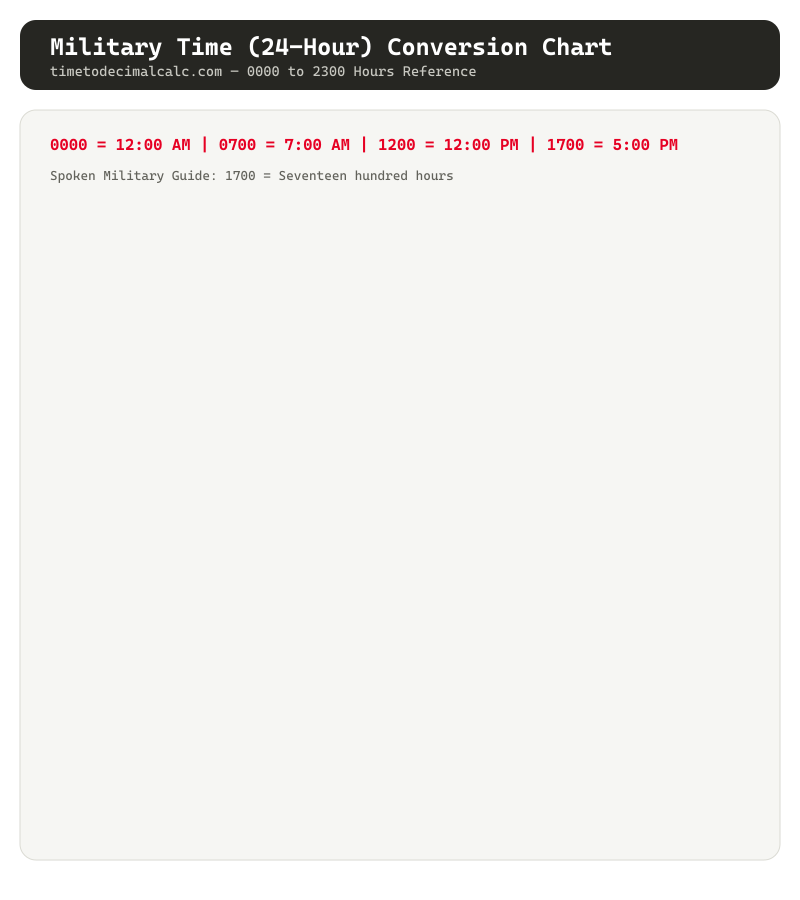
A military time chart converts between the 24-hour military clock and the standard 12-hour AM/PM system. In military time, hours run continuously from 0000 (midnight) to 2359 without AM or PM designations. For example, 0700 is 7:00 AM, 1200 is 12:00 PM, and 1700 is 5:00 PM (17 - 12 = 5).
Complete 24-Hour Military Time Chart
Official 24-hour military clock conversion table with spoken pronunciations and standard 12-hour equivalents.
Morning Hours (0000 – 1100)
AM| Military | Standard (12-Hr) | Spoken Pronunciation |
|---|---|---|
| 0000 | 12:00 AM | Zero zero zero zero hours (or Midnight) |
| 0100 | 1:00 AM | Zero one hundred hours |
| 0200 | 2:00 AM | Zero two hundred hours |
| 0300 | 3:00 AM | Zero three hundred hours |
| 0400 | 4:00 AM | Zero four hundred hours |
| 0500 | 5:00 AM | Zero five hundred hours |
| 0600 | 6:00 AM | Zero six hundred hours |
| 0700 | 7:00 AM | Zero seven hundred hours |
| 0800 | 8:00 AM | Zero eight hundred hours |
| 0900 | 9:00 AM | Zero nine hundred hours |
| 1000 | 10:00 AM | Ten hundred hours |
| 1100 | 11:00 AM | Eleven hundred hours |
Afternoon & Evening (1200 – 2300)
PM| Military | Standard (12-Hr) | Spoken Pronunciation |
|---|---|---|
| 1200 | 12:00 PM | Twelve hundred hours |
| 1300 | 1:00 PM | Thirteen hundred hours |
| 1400 | 2:00 PM | Fourteen hundred hours |
| 1500 | 3:00 PM | Fifteen hundred hours |
| 1600 | 4:00 PM | Sixteen hundred hours |
| 1700 | 5:00 PM | Seventeen hundred hours |
| 1800 | 6:00 PM | Eighteen hundred hours |
| 1900 | 7:00 PM | Nineteen hundred hours |
| 2000 | 8:00 PM | Twenty hundred hours |
| 2100 | 9:00 PM | Twenty-one hundred hours |
| 2200 | 10:00 PM | Twenty-two hundred hours |
| 2300 | 11:00 PM | Twenty-three hundred hours |
Quarter-Hour & Minute Reference Guide
In military time, minutes never change value—they are simply appended to the 24-hour prefix with no colon.
Why the Military and Healthcare Use the 24-Hour Clock
The 24-hour time system, colloquially known in North America as military time, eliminates the life-or-death ambiguities inherent in standard 12-hour AM/PM notation. In emergency medicine, law enforcement, aviation, and naval warfare, mistaking a 7:00 AM order for a 7:00 PM appointment can cause catastrophic failures.
By numbering each hour of the day sequentially from 0000 to 2359, military time guarantees absolute clarity. Today, critical civilian industries—including commercial airlines, 911 dispatch centers, train networks, and intensive care units—standardize entirely on the 24-hour clock.
Our military time chart conversion table above outlines all 24 hours alongside standard 12-hour times, phonetic spoken pronunciations, and quarter-hour increments. You can also convert specific times dynamically using our interactive Military Time Converter.
How to Convert Between Military Time and Regular Time
Converting between 12-hour standard time and 24-hour military time follows two straightforward rules:
Converting from Standard Time to Military Time
- From 12:00 AM to 12:59 AM (Midnight hour): Replace 12 with 00. For 12:30 AM, write
0030. - From 1:00 AM to 11:59 AM (Morning hours): Retain the hour, add a leading zero if single digit, and remove the colon. For 8:15 AM, write
0815. - From 12:00 PM to 12:59 PM (Noon hour): Retain the 12. For 12:45 PM, write
1245. - From 1:00 PM to 11:59 PM (Afternoon/Evening): Add 12 to the hour. For 6:30 PM:
6 + 12 = 18, so write1830.
Converting from Military Time to Standard Time
- If military time is 0000 to 0059: Add 12 to the hour and label AM (
0025 = 12:25 AM). - If military time is 0100 to 1159: Keep the hour and label AM (
0945 = 9:45 AM). - If military time is 1200 to 1259: Keep the hour and label PM (
1215 = 12:15 PM). - If military time is 1300 to 2359: Subtract 12 from the hours and label PM (
2145 - 1200 = 9:45 PM).
The Rules of Spoken Military Time
Reading military time aloud follows strict military phonetic conventions:
- Leading Zeros: Single-digit hours always begin with the word “Zero”. 0600 is spoken as “Zero six hundred hours”.
- On the Hour: Any time ending in double zeros uses the suffix “hundred hours”. 1900 is spoken as “Nineteen hundred hours”.
- Minutes: Minutes past the hour are pronounced as ordinary two-digit numbers. 1930 is spoken as “Nineteen thirty hours”, and 0705 is spoken as “Zero seven zero five hours”.
- Midnight: 0000 is spoken as “Zero zero zero zero hours” or colloquially as “Midnight”.
Complete Hourly Military Guide
Explore individual hour guides for in-depth conversion examples and spoken forms:
- 0000 Military Time (Midnight)
- 0700 Military Time (7:00 AM)
- 1200 Military Time (Noon)
- 1700 Military Time (5:00 PM)
- 1800 Military Time (6:00 PM)
- 1900 Military Time (7:00 PM)
- 2000 Military Time (8:00 PM)
- Browse all 24 hours on our 24-Hour Military Time Hub.
Legal Compliance and Standards in Time Management
Ensuring mathematical precision in time calculations is directly tied to statutory labor law compliance. In the United States, the Fair Labor Standards Act (FLSA), administered by the Wage and Hour Division of the Department of Labor, establishes non-negotiable rules governing hours worked, minimum wage, overtime compensation, and recordkeeping.
Failure to accurately track and convert employee working hours exposes employers to severe statutory penalties, including mandatory back pay, liquidated damages equal to 100% of unpaid wages, and legal attorney fees. For employees, understanding these calculation principles provides protection against unlawful wage theft and automated timeclock rounding abuses.
Key Regulatory Benchmarks to Maintain:
- The Single Workweek Rule: Overtime pay cannot be averaged across multiple weeks in a biweekly pay period. Each 7-day period (168 hours) stands strictly on its own merits.
- Accurate Decimal Conversions: Converting minutes into decimal hours for payroll must follow standard rounding to hundredths of an hour (two decimal places). Underpaying workers due to mathematical truncation violates federal law.
- Bona Fide Meal Breaks: Only meal intervals lasting at least 30 uninterrupted minutes during which the worker is completely relieved of all job duties may be deducted as unpaid time. Rest pauses between 5 and 20 minutes must legally be compensated.
Practical Industrial Scenarios and Best Practices
Different industries apply these calculation principles across specialized workflows:
1. Construction and Field Trades
Construction contractors track crew hours across multiple job sites and prevailing wage cost codes. Foreman timesheets often record arrival, morning safety meetings, lunch periods, and afternoon cleanup in 15-minute increments. Converting these records into decimal hours allows bookkeeping software to distribute labor costs accurately against specific project budgets.
2. Healthcare and Emergency Services
In hospital environments where nurses, respiratory therapists, and emergency doctors work rotating 12-hour shifts, timekeeping operates on continuous 24-hour military schedules. Shift handoffs at 0700 and 1900 require precise minute logging to ensure continuity of patient care while tracking shift differential pay premiums.
3. Legal and Professional Consulting Services
Attorneys, CPAs, and management consultants track billable client time in six-minute increments (0.10 decimal hours) or fifteen-minute increments (0.25 decimal hours). Clear, auditable conversion ensures client invoices are transparent, defensible, and free from billing discrepancies.
4. Manufacturing and Distribution Warehousing
Large-scale fulfillment centers utilize automated electronic badge readers and biometric clocks. Supervisors audit exception reports to reconcile punches where employees clocked in early or took extended breaks. Understanding standard rounding thresholds ensures fair, consistent treatment across hundreds of shift workers.
Frequently Asked Questions
Quick answers to common questions about calculations, rounding, and payroll compliance.
What is military time?
How do you read military time?
What is 1700 in military time?
What is midnight in military time: 2400 or 0000?
How do you speak military time aloud?
Where can I get a printable military time conversion chart PDF?
Related Time & Payroll Calculators
Explore related time conversion and payroll math utilities.